

How Fast Can You Get Divorced in Idaho?
When your future feels uncertain, waiting for answers can be really stressful and draining, especially when you’re unsure what’s normal or how long things might take. Many people going through a divorce share these worries, fearing their case might take a very long time.
Idaho divorce timelines vary, but understanding the process and the factors that influence timing helps make uncertainty more manageable. Knowing what to expect and control can reduce anxiety during this transition.
Below, we’ll walk through how long a divorce usually takes, common causes of delays, and factors that can help cases move faster without creating future issues.
The Shortest Possible Divorce In Idaho
Idaho law sets a few minimum timing rules that apply to most divorces, regardless of how simple or complex the case may be.
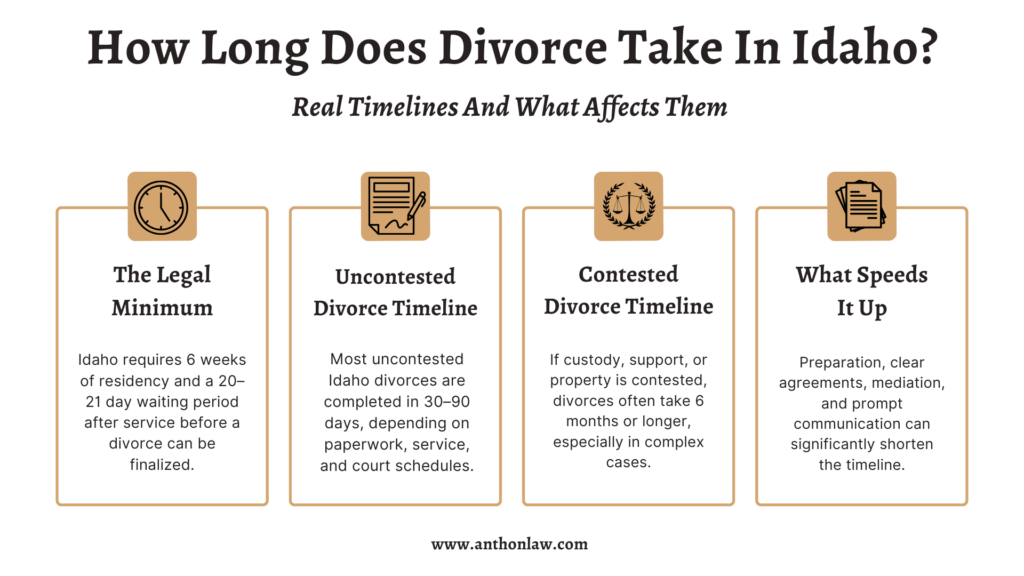
First, there is a residency requirement. Before a judge can finalize a divorce, at least one spouse must have lived in Idaho for six full weeks. This requirement doesn’t always delay filing, but it can delay the final decree if residency has not yet been met when the case is ready to conclude.
Next is the waiting period after service. Once divorce papers are formally served on the other spouse, Idaho courts generally must wait about 20 days before the divorce can be finalized. The responding spouse usually has 21 days to file an Answer, which is why many people hear that Idaho has a “three-week minimum” for divorce.
In theory, a very cooperative divorce could be finalized shortly after this waiting period. In real life, however, most cases take longer because agreements, paperwork, and court scheduling all require additional time.

Uncontested Divorce Timelines In Idaho
An uncontested divorce means both spouses reach a full agreement on all major issues. This includes property and debt division, parenting plans, child support, and spousal maintenance, if applicable.
When people ask about getting divorced “quickly,” this is usually the type of case they are referring to.
A realistic uncontested divorce in Idaho often begins with filing and service. If a spouse promptly accepts service or signs an acknowledgment, this step can proceed smoothly. If service is delayed, the entire timeline shifts with it.
Next comes the waiting period. During this time, final details are typically worked out, and documents are exchanged. This includes income information, account statements, and the final settlement terms.
Once everything is complete, the final paperwork is submitted to the court. Some judges will sign uncontested divorce decrees based solely on the written agreement, while others may require a brief final hearing. Court availability is decisive here, especially in busier counties.
In many cases, an uncontested divorce is completed within 30 to 90 days. In Ada County, timelines often fall toward the longer end of that range simply due to court volume.
Contested Divorces
A divorce becomes contested when spouses disagree on any major issue, such as custody, support, or property. Once a case is contested, the timeline changes.
Contested divorces often involve temporary orders addressing parenting time, financial support, or who remains in the home while the case is pending. They may also include exchanging detailed financial information, attending mediation sessions, or appearing at court hearings to resolve disputes.
Due to these extra steps, contested divorces often last six months or more. When high-conflict custody disputes, business ownership, or complex finances are involved, the process can take a year or longer.
Why Some Divorces Stall Out
Service issues are common, especially when one spouse lives out of state or declines service. Incomplete or incorrect paperwork can also cause delays, as courts may reject filings that are missing information or signatures.
Disputes over income, missing financial documents, or concerns about hidden assets can add significant time. Custody issues, particularly when safety concerns are involved, also require careful handling and additional court involvement.
Court schedules matter as well. In places like Ada County, hearing dates are not always immediate, even when both sides are trying to move the case forward.
What Actually Helps An Idaho Divorce Move Faster
One of the most effective ways to reduce delays is to gather financial documents early. When both sides work from the same information, negotiations tend to proceed more efficiently.
Clear and complete agreements also matter. An uncontested divorce only stays uncontested if there are no loose ends. Vague or incomplete terms often lead to delays or future disputes.
Mediation can be another powerful tool. When both spouses participate in good faith, mediation often resolves issues faster than court hearings and helps reduce conflict.
Prompt communication makes a difference as well. Responding to requests, returning paperwork, and staying engaged in the process can save weeks… or even months!

When Talking To A Lawyer Can Save Time
Some divorces are relatively simple. Others benefit from guidance early on, especially when children are involved, when significant assets are at stake, or when emotions are running high.
If you feel stuck because you don’t know what to expect next, a conversation with a lawyer can bring clarity. Understanding your likely timeline and options can reduce anxiety and help you make decisions that move your case forward instead of stalling it.
Divorce is rarely easy, but it doesn’t have to feel endless. With the right approach, many Idaho divorces can be resolved sooner than people expect.
If you’re ready to discuss your situation and get a clearer sense of your timeline, I’m happy to help. Send me a message to get started!