
Preparing for a Divorce in Idaho
Start with the records you already have and the questions you need answered. Use the checklist below for your consultation; the court forms and filing steps are explained separately.
Records to Gather Before Your Divorce Consultation
| Category | Examples to gather when available |
|---|---|
| Existing legal documents | Papers already received, prior relevant orders, and existing agreements |
| Income | Recent pay statements, tax returns, and relevant business-income records |
| Assets and debts | Available account statements, mortgage information, loan records, and property documents |
| Children | Current schedules, relevant orders, child-care costs, and insurance information |
| Questions and deadlines | Upcoming dates, missing records, and the decisions you need help addressing |
This is a preparation checklist, not a list of documents to file with the court. Bring what you have, identify what is missing, and ask how additional records should be obtained or handled.
Are You Eligible to File in Idaho?
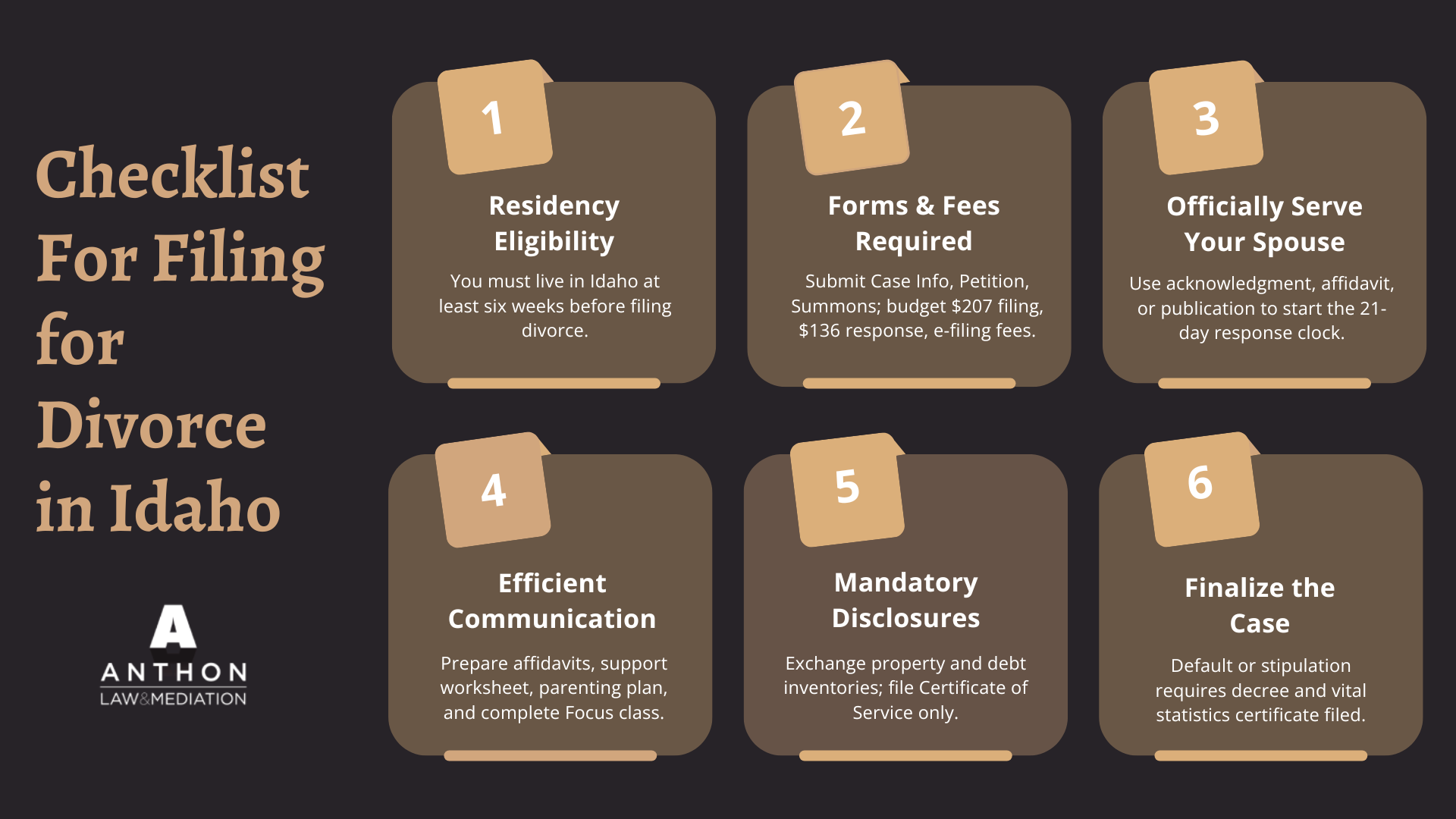
Before filling out any forms, ensure you understand Idaho’s residency requirement. To initiate a divorce in Idaho, the filing spouse must have lived in the state for at least six full weeks immediately before filing.
Meeting the state residency requirement and choosing the proper filing county are separate questions. Before filing, confirm the appropriate county for your circumstances rather than assuming it is always your own county of residence.
Court Forms Are Different From the Records You Gather
The records you gather for a consultation are different from the forms used to start or respond to a court case. The appropriate packet depends on your situation, including whether you and your spouse have minor children together and whether you are filing, responding, or finalizing the case.
The official Idaho Court Assistance Office divorce collection separates those case types and procedural stages. Use the instructions for your situation rather than treating one packet as a universal checklist.
Paperwork that Opens the Case
Every Idaho divorce begins with a small stack of “core” documents. Think of these as the keys that unlock the case:
- Family Law Case Information Sheet (CAO FL 1-1). A simple data sheet that the clerk uses to open your matter.
- Petition for Divorce. Choose the correct version: with minor children or without minor children. This sets out your grounds (most people use “irreconcilable differences”) and what you’re asking the court to decide: property, debts, support, custody, and so on.
- Summons with Orders (CAO FL 1-3). This is what you serve on your spouse. It includes standard orders (for example, not disturbing property or children) and, in cases with kids, an order to attend the parenting education program.
Tip: Use the official Idaho Court Assistance Office (CAO) packets. They’re written for non-lawyers and include forms and instructions for the selected procedure.

Filing in Ada County
Idaho courts utilize the statewide iCourt e-filing system. Attorneys must e-file, while individuals representing themselves can e-file or file in person at the clerk’s counter.
Fees do change, so always verify current amounts with the clerk or CAO before filing. If money is tight, you can request a fee waiver by submitting the Motion and Affidavit for Fee Waiver along with a proposed order.
When e-filing proposed orders or decrees, follow the redaction/confidential-filing instructions to protect sensitive information while providing the court with what it needs.
Expect two types of costs:
- Filing fees: As a general guide, plan on about $207 to start a divorce and $136 for a spouse to file a response.
- Processing/vendor fees: Small convenience charges added by the e-filing system or card processor.
“You’ve Been Served” (Nicely)
After your case is opened, you must serve your spouse with the Summons and Petition (and any court orders issued at filing). A response is generally due within 21 days after service, but check the summons, applicable rules, and any court-ordered extensions.
If your spouse does not respond within the time allowed, you may be able to request a default after meeting the procedural requirements. If they do respond, you’ll either negotiate an agreement (the easier route) or go through the contested process.
You can:
- Ask your spouse to sign an Acknowledgment of Service, or
- Use a process server or sheriff and file an Affidavit of Service.
- Can’t find them? Idaho provides a service-by-publication process with its own steps and timelines.

When Kids Are Involved
In Ada County, most cases involving children require both parents to complete Focus on Children, a brief parent education program (often available online). There’s a modest fee per parent. Judges generally won’t sign a final decree until both certificates are on file.
If you have minor children, plan on a few additional documents completed early to keep things on track:
- Affidavit Verifying Income for both parents.
- Child Support Worksheet (standard or shared/split custody).
- A detailed Parenting Plan that spells out legal decision-making, parenting time, holidays, exchanges, travel, and communication.
Mandatory Disclosures That Keep Things Honest
Under Idaho Rule of Family Law Procedure 401, required disclosures are generally due within 35 days after a responsive pleading is filed, unless an exception, written agreement, or court order applies. The information exchanged may include an Inventory of Property and Debts and income documents when child support is involved.
The Court Assistance Office instructs parties to exchange the disclosures rather than file them with the court. File the Certificate of Service showing that the exchange occurred, and ask how confidential records should be handled. Full, timely disclosure helps the parties evaluate the information needed for settlement or court.
A Realistic Timeline
The time needed to finalize a divorce depends on service, response deadlines, unresolved issues, required documents, and the court’s schedule. A minimum waiting period is not a guaranteed completion date.
For timing questions, read how long divorce takes in Idaho. For a fuller procedural explanation, see our guide to filing for divorce.
Finalizing Your Divorce: Default, Agreement, or Court Decision
Default and agreement are two possible routes to finalization. When issues remain contested, the court can also resolve them through the appropriate proceedings, including trial when needed.
Default (No Response)
If your spouse was properly served and does not respond within the allowed time, you can ask the clerk or court to enter a default and submit your Decree of Divorce with supporting documents. Default requires the applicable filings and court approval; it does not finalize the divorce automatically.
Stipulation (Agreement)
If you and your spouse settle, both of you must sign a Sworn Stipulation for Entry of Decree and submit a proposed Decree of Divorce that reflects your agreement. For cases involving children, include the Child Support Order Transmittal and make sure any required parenting class certificates are filed.
Court Decision on Contested Issues
If you cannot agree on every issue, the case may continue through the contested process. A judge may decide the remaining issues after the required proceedings. A partial agreement can still narrow what needs to be decided.
Vital Statistics Certificate of Divorce
The official Court Assistance Office divorce collection lists downloadable versions of the Vital Statistics Certificate of Divorce. The certificate remains part of the required finalization paperwork. Downloading it does not establish how your county requires it to be completed, submitted, or delivered. Confirm the current requirements with the clerk or Court Assistance Office.
Tips for Boise Residents
- Read your Summons Orders. Read when the orders take effect and follow their restrictions on property, contact, and children. Do not transfer, hide, or waste community assets in violation of an order.
- Name changes: Want your former name restored? Put it in the Petition and Decree so the court can grant it cleanly.
- Real estate and titles: If one spouse will keep the home or vehicles, plan for refinancing and title/registration changes so the decree’s terms are actually doable.

Missing Documents Should Not Keep You From Asking Questions
Bring the records already available and explain where things stand. Anthon Law can discuss the preparation and legal assistance appropriate to your circumstances.